.
.

Welcome

.
.
Make yourself at home. Put your feet up. Grab your favorite beverage and prepare to enjoy the reads.
.

.

Wednesday

Aftermath of Wild Fires


The more I have looked into the subject of the aftermath of wild fires, the more questions arose. As soon as I learned one answer, a response from another source would conflict with it for other reasons not previously considered.

What are the long-term affects on the ecology of the landscape?
If the insects and fauna have been decimated, will the plants grow too abundantly without wildlife to keep them from overproducing? Will this cause more tree diseases? Exactly what are the effects of the fire, smoke, ash and consequent winter rains upon organisms in the soil? Would it be wiser to replant only native plants? Wouldn't there be adaptable non-native species which would be more fire resistant than some of the chaparral plants that turn into ready kindling every hot dry summer? 

I discussed some of these nagging questions with my son-in-law, Scott. He was a soil specialist for the State and previous owner of one of the first organic landscaping businesses located in the Los Angeles area. He comments that fire has always been considered a natural characteristic component of the California ecosystem. Many plants and animals thrive or perish in its wake as a natural course in the scheme of things. Fires like these occurred long before the country was inhabited by humans. The dry season throughout the summer provides the right kindling. Thunderstorms producing lightning can ignite the kindling long before enough rain can soak the soil. Hence, the natural way of things is wildfires which used to burn themselves out.

In the aftermath of wild fires, the reproductive capabilities of rare plant species and the spread of invasive exotic plants are of particular concern, and it would be wiser, if possible, to replant all native plants. Yet, in the expanses of wild lands, spring plants and flowers are diverse after a fire and provide an abundant source of food which may help to replenish the range and numbers of various species. As caretakers of our lands, we must determine what is the best action to take in order to restore the land to healthy reproductivity.

Scott points out that some native plants naturally hold more moisture and are less likely to encourage fire to spread. Some naturally thrive due to the after-effects of fire such as soil enriched by ash or simply because enough has been burned away that there is now room for new plants to grow. Many non-native plants may have been destroyed,  and it is best not to attempt replacing them. As a previous student of fire science Scott assured me that the fire retardant dropped from airplanes onto the hillsides are not poisonous chemicals, but safe for the land and rich in nitrogen and potassium. Therefore, helpful to increasing verdant re-growth.

Scott also related an experience he had during one of the fires, which, if could be simulated, would make a lot of money for some insecticide company. He told me that the week before the fires, he had been treating one of his neighbor's properties for an infestation of whiteflies with an organic product that takes several applications over a period of weeks. Scott spent a great deal of time observing the fires in his own neighborhood before evacuation. He was struck by the incredible thickness of the smoke which permeated everything. After the fires subsided, he returned to make the follow-up application on the whiteflies, only to discover that they were completely gone, with no further signs of infestation. And there have been no recurrences since then. Scott came to the conclusion that the smoke was the cause of their demise. Now, if only we could bottle that pest cure!! Perhaps we just need to smoke them out!

I have come to the conclusion that it is a more complicated subject than can be answered with simplicity. It is a lot like Philosophy. All answers lead to other questions.

Note: the picture is of one of the large Redwood trees that grow in the vicinity. This one is only a couple hundred years old, yet it is large enough for a man to seem minuscule standing before it.

Tuesday

Fire Breaks and Ankle Break


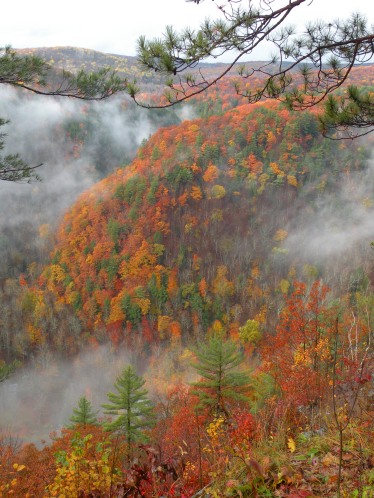
I recall as a little girl, my father driving the car through forested Allegheny Mountains  on old, out-of-the-way firebreak roads. My mother questioned the wisdom of taking such mountaintop detours but I know she enjoyed the adventure as much as the rest of us. Crisscrossing the ridges, we crept along the brink overseeing vast valleys until the tracks grew too narrow to pass. Both fascinated and terrified, I clung to the edge of the open window and gazed down the steep inclines through the lush green treetops. Oak leaf mold, pine needles, moist soil and a thousand varieties of plants tantalized my nose as the gaping canyons threatened to swallow the car. Daddy knew those firebreak roads like the back of his hand. He had worked clearing them for payment of fifty cents a day (plus room and board at the camps) as a member of the CCC's (Civil Conservation Corps) in the post-depression era. He explained how summer dryness, human carelessness, or the whims of Mother Nature made the firebreak roads necessary. Not too long ago, I wondered if there were sufficient firebreaks being created today. Unfortunately, one of the biggest forest fires we had this summer was on acres and acres of land that had not been cleared in over sixty years.

As an adult, while living in the tree populated hills of Aptos in 1981, I recall one hot, dry evening a neighbor's very large, faulty propane tank exploded, shooting flames fifty feet to the tops of the Eucalyptus grove. Instantly, I grabbed my 2 year old son out of bed, ran to the edge of a six foot fence, lifted him over, and gently dropped him upright. Thank heavens he was wearing his red foot ‘jamas. Then, I vaulted over as the increasing roar of the flames urged me to fly. Anyone who knows me, is aware I do not have the physique of an athlete. I landed hard, and broke my ankle but the adrenaline kept me from realizing it until the next day, when I discovered I couldn’t walk.

Running while the flames screamed through the trees, I carried my son through the neighboring pasture, and down to the highway. I sat beside the road as the fire department arrived to put out the fire before the hillside became engulfed. That hair-raising event is stamped indelibly on my mind.

The next day we surveyed the burned trees, and I thought how sad that they were gone. Foolish me. What did I know? They were not as destroyed as they appeared. And now, years later, the average person would not recognize these trees as having survived. They have grown back strong as before. Research has shown that no matter how singed the trees, as long as the root system, and trunk are reasonably uninjured, they are likely to recover healthy again, in time.


This summer, south of me, what began as a "Controlled Burn" combined with the thick, desiccated undergrowth, high temperatures, and brisk winds quickly consumed acreage becoming a wildfire which engulfed and incinerated acres of trees, coastal scrub, and grasses. No longer a “controlled burn” this transformed much of the terrain that lasted several days. From the beginning, with expert assistance the fire was contained before it spread too far.

At the same time, Southern California's wildly unmanageable firestorms were not as easily controlled. I watched the news, distractedly wondering if all life in the Los Angeles Basin would be incinerated. Literally, full neighborhoods disappeared. Folks have suffered, most all have survived and are rebuilding their homes.

But, still I’m wondering, what plants, insects, birds,  and other wildlife were destroyed in the process? How well will the ecosystem recover? I once read a science fiction book entitled Earth Abides by George Rippy Stewart which extolled the virtues of Mother Nature's ability to survive, and thrive long after the human race had annihilated itself. (Some people survived too) In opposition to those who are proponents of the "we will take her with us" group, I am rooting for Mom.